Navigating the Shift: How the 2025 Tax Act Impacts Small Businesses in Nigeria
How the Nigeria Tax Act 2025 transforms SME tax affairs—CIT exemptions, VAT thresholds, capital gains relief, and compliance tips.
Tax Affairs Team
Tax Advisory

The Nigerian tax ecosystem has historically been a maze of complex regulations, overlapping jurisdictions, and unpredictable enforcement. For small and medium-sized enterprises (SMEs), managing tax obligations often felt less like a civic duty and more like a systemic penalty on growth.
However, the enactment of the Nigeria Tax Act (NTA) 2025—which consolidated fractured tax frameworks into a unified legal system effective from January 1, 2026—marks one of the most radical structural overhauls in the country's economic history. Designed to drive formalization, curb tax evasion at the top, and shield micro, small, and medium enterprises (MSMEs), this landmark legislation directly impacts how you run your business, manage cash flow, and handle compliance.
If you operate an SME in Nigeria, here is a detailed, well-researched breakdown of how the 2025 Tax Act fundamentally transforms your tax affairs.
1. Redefining the "Small Business": The New Thresholds
Under previous laws, a small company was primarily categorized using a basic ₦25 million turnover baseline. The 2025 Tax Act introduces a dual-metric categorization that aggressively widens the safety net for small businesses, while completely abolishing the "medium-sized company" classification.
To qualify as a Small Company under the new law, your business must meet the following criteria:
- Annual Gross Turnover: ₦100 million or less.
- Total Fixed Assets: Not exceeding ₦250 million.
⚠️ The Professional Services Exception: It is critical to note that if your business provides specialized professional services (e.g., legal practices, accounting firms, tax consultancies, or engineering partnerships), you are automatically excluded from small business reliefs, regardless of how low your turnover or fixed asset metrics are. Professional services are taxed at standard corporate rates from day one.
2. Total Exemption from Corporate Income Tax (CIT)
For qualifying small businesses, the primary headline of the 2025 Tax Act is the 0% Company Income Tax (CIT) rate.
If your annual turnover stays under the ₦100 million mark and your fixed assets are under ₦250 million, your business is legally exempt from paying corporate taxes on its profits. This gives small business owners complete ownership over their hard-earned margins, allowing them to retain capital for inventory, hiring, and expansion.
The Death of the Minimum Tax
Historically, one of the most punitive aspects of Nigerian tax law was the "Minimum Tax" rule. Even if your business suffered a terrible year and recorded a net financial loss, you were legally forced to pay a percentage of your gross turnover (0.5%) as tax.
The 2025 Act completely abolishes the minimum tax for companies with no taxable profits. The state now aligns corporate tax expectations strictly with performance, ensuring that an unprofitable year does not trigger a liquidity crisis for vulnerable businesses.
3. The End of Multiple Levies: The Consolidated Development Levy
For decades, small businesses have complained about the "multiplicity of taxes." Business owners had to separately calculate, track, and remit the Tertiary Education Tax (TET), the National Information Technology Development Agency (NITDA) Levy, the National Agency for Science and Engineering Infrastructure (NASENI) Levy, and the Police Trust Fund Levy.
The 2025 Tax Act solves this administrative headache by introducing a unified 4% Development Levy on assessable corporate profits, which completely absorbs and replaces those independent, fragmented sector levies.
The Win for Small Businesses: Small companies are fully exempt from this new 4% Development Levy. While larger corporations face this consolidated rate, your small business sidesteps both the financial cost and the bureaucratic nightmare of handling multiple government collection agencies.
4. Value Added Tax (VAT) Adjustments & Threshold Changes
Value Added Tax undergoes a phased structural shift under the new legislation. The Act puts in place a long-term roadmap that seeks to increase the baseline VAT rate incrementally (moving from the historical 7.5% toward 10%, and eventually 15% by 2030).
However, protective mechanisms have been engineered to prevent this from crushing small business consumer bases:
- The ₦50 Million VAT Threshold: The law establishes a ₦50 million annual turnover threshold for VAT compliance. If your business generates less than ₦50 million, you are exempt from charging, collecting, or remitting VAT on your sales.
- Essential Goods Safeguards: To combat inflation, basic consumer staples—including locally produced food items, educational materials, basic healthcare services, residential rent, and public transportation—are permanently locked at 0% VAT or fully exempt.
- Input VAT Credit Expansion: If your business crosses the threshold and must register for VAT, the 2025 Act brings a massive relief. Businesses can now claim tax credits for VAT paid on all purchases—including services and overheads—not just on raw materials or direct inventory. This minimizes double taxation and directly lowers production overheads.
5. Capital Gains Tax (CGT) Overhaul
To eliminate tax arbitrage, the standard Capital Gains Tax (CGT) rate on asset disposals for large corporations has been hiked significantly from 10% to 30%, matching the standard corporate income tax rate.
If a large company sells a piece of land, a building, or heavy machinery, they will surrender nearly a third of that profit to the Federal Government.
The Small Business Protection: Once again, the Act carves out a special shelter for small businesses. Qualifying small companies enjoy a 0% Capital Gains Tax rate on asset disposals. If you need to sell off an older business vehicle, a warehouse, or processing equipment to upgrade your operations, you keep 100% of the proceeds. This enables smoother operational scaling and asset optimization without frictional tax costs.
6. Personal Income Tax (PIT) and the Business Owner
A common point of confusion for entrepreneurs is separating the business from the business owner. While your small company enjoys a 0% corporate tax rate, you as an individual are still subject to Personal Income Tax (PIT) on any personal income, allowances, or salaries you draw from the enterprise.
Personal Income Tax is paid to your state's Internal Revenue Service (e.g., LIRS in Lagos, NRS/IRS in other states) under a newly modernized, highly progressive tax band system:
| Annual Taxable Income Band | Applicable PIT Rate |
|---|---|
| First ₦800,000 | 0% (Fully Exempt) |
| Next ₦2,200,000 | 15% |
| Next ₦9,000,000 | 18% |
| Next ₦13,000,000 | 21% |
| Next ₦25,000,000 | 23% |
| Above ₦50,000,000 | 25% |
Key Takeaway for Owners: If you earn ₦800,000 or less annually, you are completely exempt from personal income tax. This aligns tax obligations with the national minimum wage. However, high-earning individuals making over ₦50 million annually face a steeper progressive top rate of 25%.
Additionally, the Act introduces a generous rent relief mechanism—allowing an individual taxpayer to claim a relief equal to 20% of their annual rent paid (capped at ₦500,000 per year), provided full landlord disclosures are made.
7. The Golden Catch: Exemption Does Not Mean Avoidance
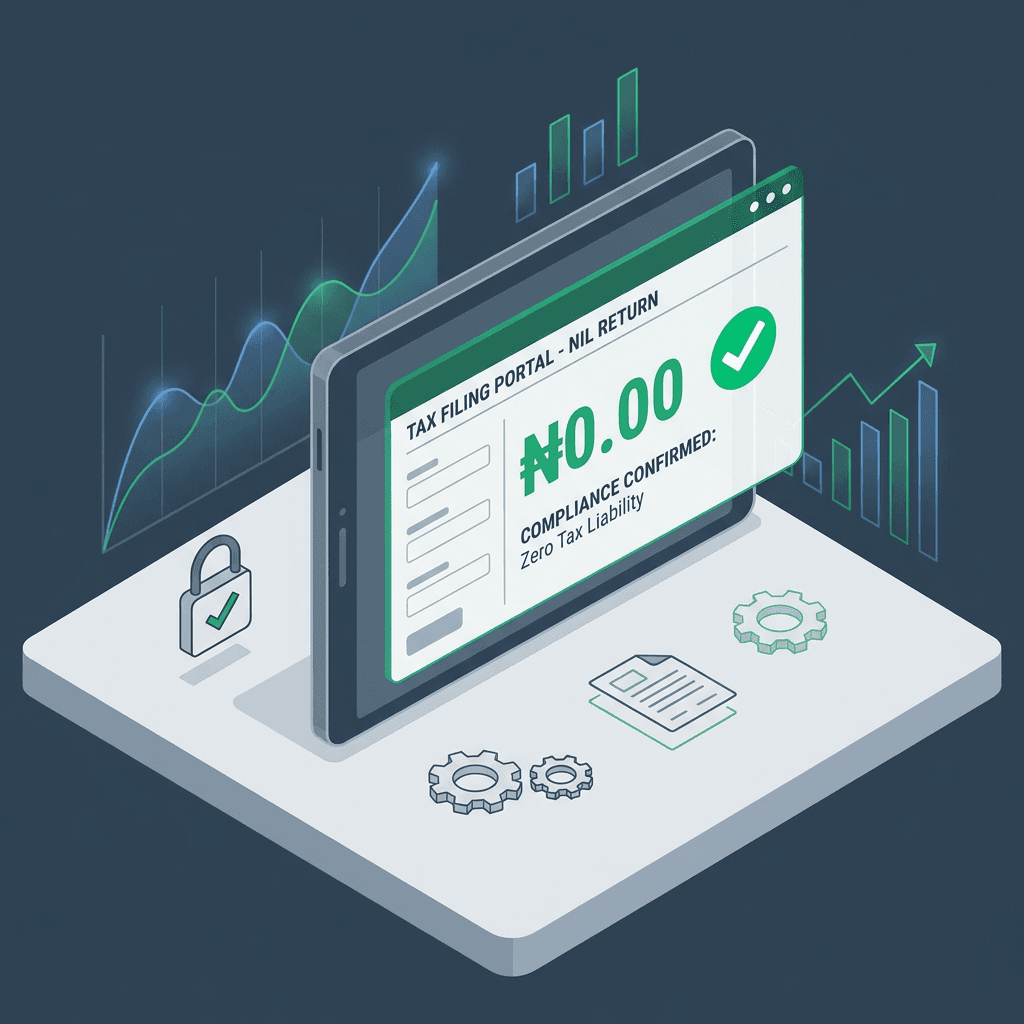
The single biggest mistake a Nigerian small business owner can make under the 2025 Tax Act is assuming that a 0% tax rate means zero paperwork.
The Nigeria Tax Administration Act (NTAA) explicitly mandates that every registered business enterprise—taxable or exempt—must file an annual tax return.
Why Filing Matters
- Retention of Status: Your status as an "exempt small company" is validated only when you file your financial position annually. If you fail to file, you can lose your exemptions, face heavy administrative penalties, and be treated as a non-compliant entity.
- No TIN, No Banking: The 2025 framework strictly links your Tax Identification Number (TIN) to commercial operations. Financial institutions are legally required to verify active TINs for corporate accounts. If your tax status falls into default, your business bank accounts face operational restrictions.
- Objective Deductibility Rules: For businesses that do cross into the taxable brackets, the Act has abolished the old, highly subjective "Reasonably, Reasonably and Necessarily" test for business expense deductions. Now, as long as an expense is objectively documented, compliant with tax laws, and used for actual business operations, it qualifies for deduction—significantly reducing arbitrary disputes with tax auditors.
Action Plan for Nigerian Small Businesses
To fully capitalize on the 2025 Tax Act without falling into non-compliance traps, implement this three-step checklist immediately:
- Formalize and Separate Accounts: Ensure your business is registered with the Corporate Affairs Commission (CAC) and has a dedicated corporate bank account. Never mix personal spending with company funds, as this blurs individual PIT and corporate CIT boundaries.
- Maintain Clean Financial Records: Track your gross annual turnover closely. If you cross the ₦50 million or ₦100 million thresholds mid-year, your VAT and CIT liabilities shift immediately.
- File Annually Without Fail: Work with a licensed tax professional to compile your statement of affairs and file returns before statutory deadlines, ensuring your 0% corporate and asset tax statuses remain securely locked in.
The 2025 Tax Act is structurally designed to support small business sustainability. By removing the threat of arbitrary minimum taxes and eliminating multiple levies, the government has provided an environment for growth. Your responsibility as an entrepreneur is to step up, stay organized, and remain compliant.
Disclaimer
Tax compliance is highly individualized. While these strategies are based explicitly on the Nigeria Tax Act 2025 provisions, always consult a certified tax professional or accountant to evaluate your specific financial profile before making major restructuring decisions.